
2025
Our President for 2025/6 was:
Professor Peter Garside
He proposed the Toast to Sir Walter at our 116th Annual Dinner on 7th May 2026.
Download the [transcript]
Summary of the Speech:
Prof. Peter Garside begins with a warm, humorous reflection on his long involvement with the Sir Walter Scott Club over more than twenty years. He contrasts the hard work of committee roles (Secretary, Chairperson, etc.) with the more ceremonial prestige of finally becoming President, describing it as a long-awaited moment of “supposed glory”.
He then touches on the amusing fact that he has become the Club’s oldest-ever President, narrowly surpassing Fraser Elgin. This leads into a thoughtful comparison between modern attitudes to age and earlier eras, before shifting the focus to Scott himself — who, despite his monumental reputation, died comparatively young. Prof. Garside uses this to gently remind the audience not to see Scott only as a towering genius, but also as a man who endured immense pressure, ill health, and hardship. He recalls Dame Jean Maxwell-Scott referring to Scott simply as “that poor man”, a phrase that captures this more human perspective.
From there, Prof. Garside describes earlier connections with the Club, including his contribution to the Club’s centenary publication Talking About Scott (1994). He recalls the energy of that period in Scott scholarship, especially the emergence of the Edinburgh Edition of the Waverley Novels, which promised to strip away Victorian editorial distortions and restore Scott’s authentic voice.
A key theme emerges: Scott’s sense of uncertainty and contingency — the “what if?” nature of life. Prof. Garside illustrates this with a powerful quotation from Scott’s 1825 journal, where Scott looks back on his turbulent life and wonders what the end of it will be. He argues that this awareness of shifting fortunes runs throughout the novels, where characters are swept along by the forces of history.
Prof. Garside then moves into an engaging autobiographical account of how he himself came to Scott. He explains that as a student at Cambridge in the early 1960s he had read no Scott at all, largely due to the influence of literary critics such as F. R. Leavis, who dismissed Scott as artistically second-rate. It was only later, during postgraduate study at Harvard, that he encountered Scott in a new light: as a crucial figure in the development of historical writing and social-historical fiction. He credits Edgar Rosenberg and also the influence of Georg Lukács’ The Historical Novel, which placed Scott at the centre of a European tradition.
Returning to the present, he reflects on how far Scott studies have advanced since the 1990s. He praises the completion of the Edinburgh Edition of the Waverley Novels, the ongoing Edinburgh Edition of Scott’s poetry, and the more sophisticated ways scholars now place Scott within the wider cultural life of Edinburgh and Scotland. He notes that older simplistic political interpretations of Scott have faded, and he also highlights the importance of modern heritage work — especially the restoration of Abbotsford and more recent projects such as Lee Simpson’s online mapping of Scott-related Edinburgh locations.
The latter part of the address becomes more specialised and particularly interesting: Prof. Garside identifies biography as the major unresolved puzzle in Scott scholarship. He focuses on John Gibson Lockhart’s Life of Scott, long regarded as a masterpiece but heavily criticised in modern times for distortions, selectivity, and occasional dishonesty.
At this point, Prof. Garside reveals a significant personal project: he has been working for several years on a new edition of Lockhart’s biography, and it has just been submitted to Edinburgh University Press. He then outlines why Lockhart’s biography deserves revaluation, stressing that it is not a fixed single work but a text that went through multiple editions, expansions, abridgements, and reshaping — all influenced by family pressures, commercial publishing demands, and tragedy (especially the death of Lockhart’s wife Sophia, Scott’s daughter).
He compares the vast original multi-volume biography (almost 900,000 words) with the later abridged version (about 285,000 words). He argues persuasively that the abridged version is more vigorous, more readable, and often more emotionally powerful, particularly in Lockhart’s first-hand recollections of Scott’s final decline. He notes the deeply moving scenes of Scott’s failing mind and body — including his struggles with writing and his turning toward spiritual texts from memory.
Prof. Garside concludes by explaining that his new edition will provide detailed explanatory and textual notes, while preserving the narrative force of Lockhart’s biography. He ends by raising the glass to Scott’s memory, especially as revealed through Lockhart’s unique “window” onto the man.
Interesting Points:
- The tone is unusually well balanced: humorous and conversational at the start, but increasingly reflective and emotionally resonant as it moves toward Scott’s later life and death.
- The “what if?” theme is an excellent interpretative device. It links Scott’s personal anxieties, the unpredictability of history in the novels, and Prof. Garside’s own unexpected journey into Scott scholarship.
- Prof. Garside offers a fascinating glimpse into how Scott was treated (or dismissed) by mid-20th century academic criticism, especially through the influence of F. R. Leavis.
- The speech quietly emphasises how Scott’s reputation has been rebuilt through major scholarly projects — particularly the Edinburgh editions — and how Edinburgh itself is now physically and digitally reasserting Scott’s presence.
- The most significant headline moment is his announcement that he has completed a major new annotated edition of Lockhart’s Life of Scott, newly delivered to Edinburgh University Press.
- His defence of Lockhart is nuanced: he acknowledges the criticisms, but argues that some of the more questionable anecdotes carry symbolic or “emblematic” meaning, and that Lockhart’s closeness to Scott gives his account a unique emotional authenticity.
- The description of Scott’s final fragility (loss of recognition, inability to write, retreat into remembered spiritual texts) is one of the most powerful and memorable passages of the entire address.
Download the [transcript]
List of Members Present
On Thursday 7th May 2026, the Annual Dinner of the Club took place in the New Club, Edinburgh. Madeleine Mackenzie (Chairperson) presided over a company of 33 members and guests:
William Agnew, Margaret Bennett, Maidie Cahill, Ian Chisholm, Jonathan Cobb, Kristófer Dignus, Penny Fielding, Richard Fellows, Prof. Peter Garside, Gillian Garside, Marion Gilmore, Rosaleen Harley, Edward Hocknell, Joan M Houston, Robert Irvine, Hugh Lockhart, Prof. Alison Lumsden, David McClay, Ainsley McIntosh, Gonzalo Mazzei, Jeremy Norman, Prof. David Purdie, Lee A. Simpson, Donald Smith, Lord Stewart, Lady Stewart, Paul Sweetnam, Prof. Sir Iain Torrance, Lady Torrance, Michael Turpie, Benedikte Uttenthal and Eric Wishart
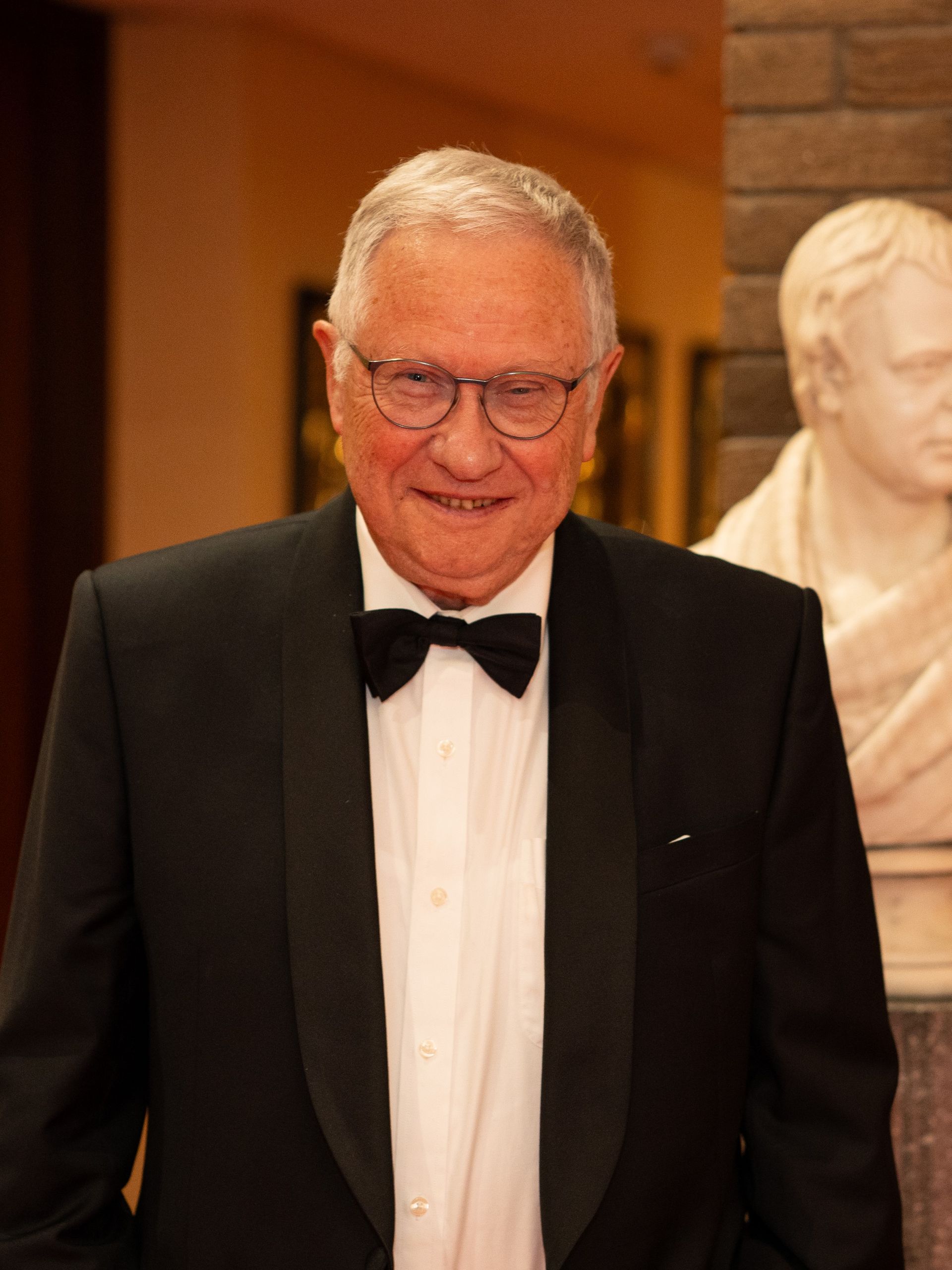
Peter Garside was educated at Cambridge and Harvard Universities and taught English Literature for more than thirty years at Cardiff University, where he became Professor of English and Director of the Centre for Editorial and Intertextual Research. Subsequently he was appointed Professor of Bibliography and Textual Studies at the University of Edinburgh, where he is now a Professorial Fellow. He served on the Boards of the Edinburgh Edition of the Waverley Novels and the Stirling / South Carolina Collected Edition of the Works of James Hogg and has produced three volumes a piece for these endeavours, including Scott’s Waverley and Hogg’s Confessions of a Justified Sinner. He was one of the general editors of the ground-breaking bibliographical survey The English Novel 1770-1829 (OUP, 2000) and has since co-edited the critical collection English and British Fiction 1750-1820 (OUP, 2015). He has also directed two online databases in British Fiction 1800-1829 (2004) and Illustrating Scott (2009). More recent work includes editions of Walter Scott’s Shorter Poems (EUP, 2020) and J. G. Lockhart’s Peter’s Letters to His Kinsfolk (2 vols, EUP, 2022). His current project is a critical edition of Lockhart’s Life of Scott.
Peter has long been involved in the Club’s activities, writing the Introduction to
Talking About Scott (1994), a compilation of past Presidential Addresses, and serving as Secretary between 2010 and 2015, and Chairman between 2016 and 2019. His essay on
"The Scott Family Graves" is one of the most visited blog on the Club website.
Subsidiary Toast Summary:
David McClay proposed the Toast celebrating the Scottish Storytelling Centre and Edinburgh’s storytellers, linking their work to Sir Walter Scott’s enduring influence. He argues that storytelling was one of Scott’s defining gifts, not only through his famous novels but also through his poetry, letters, criticism, and his lifelong enthusiasm for ballads and oral tradition.
He highlights how Scott used storyteller figures in his writing to present multiple viewpoints, often blending history with folklore and the supernatural. McClay supports Scott’s reputation with vivid accounts from Washington Irving and James Hogg, who both praised Scott’s conversational brilliance, humour, memory, and ability to bring scenes to life.
He closes with a humorous warning from Scott himself about the dangers of an overly “determined storyteller”, before formally calling for the toast.
Donald Smith’s reply focuses on Sir Walter Scott’s defining strength as a “connector” — someone who collaborated widely, encouraged others, and helped shape Scotland’s cultural identity through conversation across generations. He argues that literature is not simply texts, but a living dialogue between writers and readers, carried forward over centuries.
He illustrates this through three main examples: Scott’s relationship to medieval chroniclers like Walter Bower; Scott’s literary circle and his lively tensions with James Hogg; and Scott’s deep involvement with theatre, including the famous 1827 dinner where he publicly acknowledged authorship of Waverley. Smith concludes by stressing Scott’s generosity, hospitality, and creative solidarity, arguing that these collaborative instincts make Scott especially relevant in today’s creative industries.
Interesting Points:
- Donald Smith’s humorous anxiety about “replying to a toast” (with memories of the Traverse Theatre and Tarbolton Bachelors’ Club) is a great opening and gives his speech warmth and personality.
- The idea of literature as a “conversation across centuries” is a strong, memorable theme and ties the whole reply together neatly.
- The quotation from Walter Bower’s closing Latin poem (“He is not a Scot who is not pleased with this book”) is striking and would make an excellent standalone highlight.
- The anecdote of James Hogg and Scott arguing over The Brownie of Bodsbeck versus Old Mortality is vivid, funny, and revealing — it shows Scott as both opinionated and engaged, rather than distant or untouchable.
- The 23rd February 1827 dinner is presented not just as a literary moment (Scott admitting authorship of Waverley), but as an emotionally significant turning point: his first major public appearance after Charlotte Scott’s death.
- The detail that the theatre fundraiser dinner had no women present, despite being for Harriet Siddons, is a powerful historical irony and provides a sharp modern angle.
Vote of Thanks:
Professor Margaret Bennett closed the evening with a warm vote of thanks, praising the speakers and reflecting on storytelling as a vital human force — something that builds wellbeing and companionship, especially in a modern world increasingly dominated by screens and isolation.
