

Walking Tour: Stop J
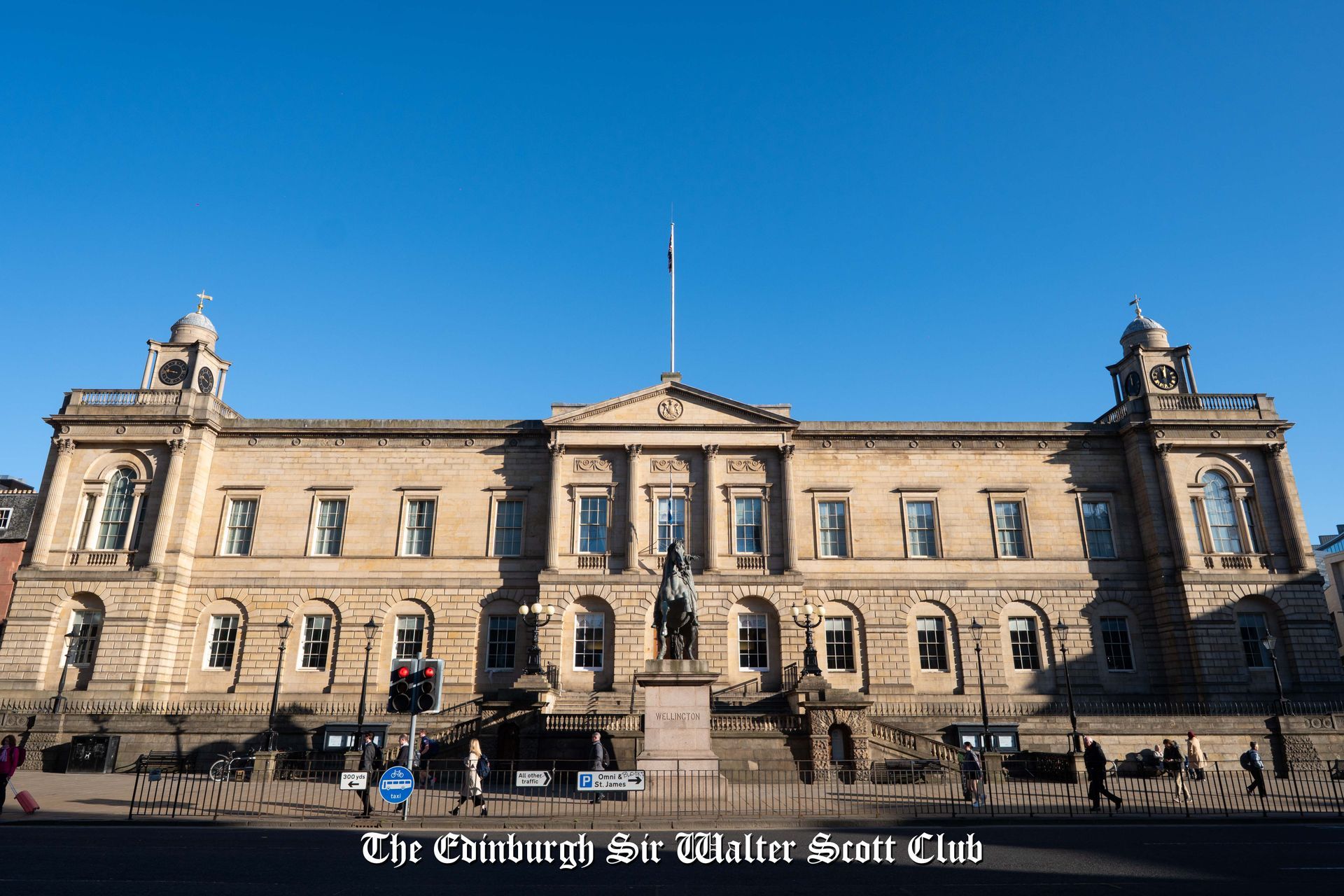
General Register House
2 Princes Street, EH1 3YY

Scotland’s national archive building connected with Sir Walter Scott’s legal and antiquarian world.
GPS Coordinates: 55°57'13.2"N 3°11'21.3"W
Scott Connection:
Sir Walter Scott served as Principal Clerk of Session from 1806, an office associated with the management of court records.
Date Range Relevant to Scott: 1806–1832
Current Status:
Historic government building housing part of the National Records of Scotland.
Accessibility:
Exterior viewing from Princes Street and St Andrew Square; public access varies depending on official use. (Exterior viewing only.)
Why This Place Matters
General Register House was built to house Scotland’s national records, including charters, legal registers, and government documents. Completed in stages from the late eighteenth century onward, the building became the central repository of the nation’s documentary history.
Sir Walter Scott’s professional life as a lawyer and court official placed him within the world of legal records and historical documents preserved here. Although his official duties as Principal Clerk of Session were centred in Parliament House, the records stored in Register House formed part of the documentary environment that shaped both legal practice and antiquarian scholarship in early nineteenth-century Edinburgh.
The building therefore represents the archival foundations of the historical imagination that informed Scott’s writing.
Historical Context
Scott’s office as Principal Clerk of Session was known as Dalrymple’s Office, part of the administrative machinery of the Court of Session. Contemporary legal manuals indicate that Dalrymple’s Office was located at the east end of the first floor of General Register House.
It is likely that Scott would have visited the rooms associated with his department when dealing with court records, though references to such visits are rare in his surviving letters and journals. Much of his daily work as a Clerk of Session appears to have been conducted in connection with the courts at Parliament House.
The precise arrangement of offices within Register House during Scott’s lifetime remains uncertain, as early plans of the building do not clearly show the allocation of rooms once construction was completed.
Scott Here
Scott’s office as Principal Clerk of Session was known as Dalrymple’s Office, part of the administrative machinery of the Court of Session. Contemporary legal manuals indicate that Dalrymple’s Office was located at the east end of the first floor of General Register House.
It is likely that Scott would have visited the rooms associated with his department when dealing with court records, though references to such visits are rare in his surviving letters and journals. Much of his daily work as a Clerk of Session appears to have been conducted in connection with the courts at Parliament House.
Recent research suggests that the department known as Dalrymple’s Office, to which Scott belonged as a Principal Clerk of Session, occupied rooms on the east side of the First Story (raised ground floor) of General Register House. On Robert Adam’s 1775 plan of the building the room is marked “10”, and may represent the location of Scott’s working office within the structure.
The building housed not only national records but also large collections of Court of Session case papers (“processes”), some more than a century old. These formed part of the working legal archive used by the clerks of court.
The Bigger Theme
General Register House illustrates the importance of documentary evidence in the intellectual culture of Scott’s Edinburgh. The preservation and study of historical records formed a crucial part of the antiquarian scholarship that flourished in the city during the late eighteenth and early nineteenth centuries.
Through his legal career and his friendships with antiquaries such as Thomas Thomson, Scott moved within a community deeply engaged with Scotland’s documentary past. The archival world represented by Register House therefore formed part of the scholarly environment that informed Scott’s historical writing.
Literary Connections
Scott’s historical novels are notable for their careful use of documentary detail and legal context. His professional experience in the legal system and his interest in historical records contributed to the distinctive realism of works such as the Waverley novels.
The archival culture centred in buildings like General Register House helped shape the broader intellectual framework within which Scott wrote.
What to Notice On Site
General Register House occupies a prominent position at the east end of Princes Street. The building’s domed central structure reflects Robert Adam’s neoclassical design for a national archive worthy of Scotland’s historical records.
Questions to Consider
How did the preservation of historical records influence the study of Scotland’s past?
What role did legal and archival institutions play in shaping the intellectual culture of Scott’s Edinburgh?
How might access to historical documents have influenced Scott’s approach to writing historical fiction?
Further Reading
Lockhart, J. G. -
Memoirs of the Life of Sir Walter Scott.
Millgate, Jane. -Walter Scott: The Making of the Novelist.
National Records of Scotland. “250 Years On: Sir Walter Scott and Register House.”
Did You Know?
Scott’s close associate Thomas Thomson, appointed Deputy Clerk Register in 1808, worked in General Register House and became one of Scotland’s leading legal antiquaries. Thomson was also a founding member and later Vice-President of the Bannatyne Club, the antiquarian society established by Scott in 1823.
Scott’s brother Thomas Scott briefly served as an Extractor in the Court of Session (1808–09), a role connected with the preparation of legal documents preserved in the national records.
Official Website