
William Laidlaw and the 1912 Memorial at Contin Parish Church
1912
A Bronze and Marble Tablet was erected by the Club in Contin Parish Church to the memory of William Laidlaw. (Sir Walter amanuensis)
A bronze and marble tablet was erected by the Club in Contin Parish Church to the memory of William Laidlaw, Sir Walter Scott’s amanuensis.
The following text was recorded in the Club’s [1912 bulletin]:
In the Spring of the present year (1912) a Tablet was erected by the Club in Contin Parish Church to the memory of Willie Laidlaw. The Tablet, which is 21½ ins. by 18 ins., was designed by Mr J. D. Cairns, Architect, George Street, and was cast in bronze by Messrs Wm. Bryden & Son, George Street. It is surrounded by a border of vert egypte marble, and contains the following inscription:—
“In kindly memory of Willie Laidlaw, amanuensis to the author of ‘Waverley,’ who lies buried in Contin Churchyard. Erected by the Edinburgh Sir Walter Scott Club, 1912.”
The Tablet, which is a very beautiful one, was unveiled in presence of a representative gathering by Sheriff M‘Intosh, who recalled the facts of Laidlaw’s life, and said it was a happy thought of the Scott Club thus to mark his last resting place in Contin Churchyard.
The wording is clear and unambiguous: the memorial was erected not merely to honour Laidlaw’s association with Scott, but to mark his burial in Contin Churchyard.
Who was William Laidlaw?
William Laidlaw (1780–1845) was born at Blackhouse in Selkirkshire. A shepherd and farmer by background, he possessed a deep knowledge of Border song and tradition. He first came into contact with Sir Walter Scott in the early years of the nineteenth century and soon became one of Scott’s most trusted associates.
Laidlaw is best remembered as Scott’s amanuensis. During the most productive years of Scott’s literary career, he transcribed manuscripts, prepared fair copies, and assisted with the practical management of an extraordinary output of poetry and fiction. Among the works composed during the period of his close assistance were The Bride of Lammermoor, A Legend of Montrose, and Ivanhoe. His role was not mechanical; he was a steady presence, a practical mind, and a loyal friend.
Laidlaw also wrote poetry of his own. His song Lucy’s Flittin’, published in The Forest Minstrel (1810), remains a notable example of Scots verse from the period.
Laidlaw’s final years in Ross-shire
In later life Laidlaw moved north and served as a factor in Ross-shire. When ill health forced his retirement, he settled in Contin, where he died on 18 May 1845.
A gravestone in Contin Churchyard commemorates William Laidlaw and his wife Janet Ballantyne. The existence of this grave marker corroborates the 1912 tablet’s statement that he “lies buried in Contin Churchyard”. The stone was restored in 1958 by descendants, demonstrating that family memory of his burial place remained strong well into the twentieth century.
Thus the Club’s memorial of 1912 was rooted in the physical reality of the churchyard itself. It marked not simply a literary association, but a Highland resting place.
The 1912 memorial in context
The memorial tablet, designed by J. D. Cairns and cast by Wm. Bryden & Son, reflects the seriousness with which the Club approached its task. Bryden & Son were respected bronze founders in Edinburgh, and the use of vert egypte marble framing gives the piece dignity and permanence.
The unveiling by Sheriff M‘Intosh before a representative gathering shows that the event was regarded as one of local and literary significance. The Sheriff’s remarks, recalling the facts of Laidlaw’s life, suggest that his contribution to Scott’s achievement was already appreciated a century ago
.
A quiet but essential figure
Scott’s fame has often overshadowed those who assisted him. Yet without the steady hand and loyal support of William Laidlaw, the immense literary output of those years would have been harder to sustain.
The tablet in Contin Parish Church remains a reminder that great works are sometimes the product not only of genius, but of faithful collaboration. In marking Laidlaw’s grave in 1912, the Edinburgh Sir Walter Scott Club honoured one who stood quietly but indispensably beside the Author of Waverley.
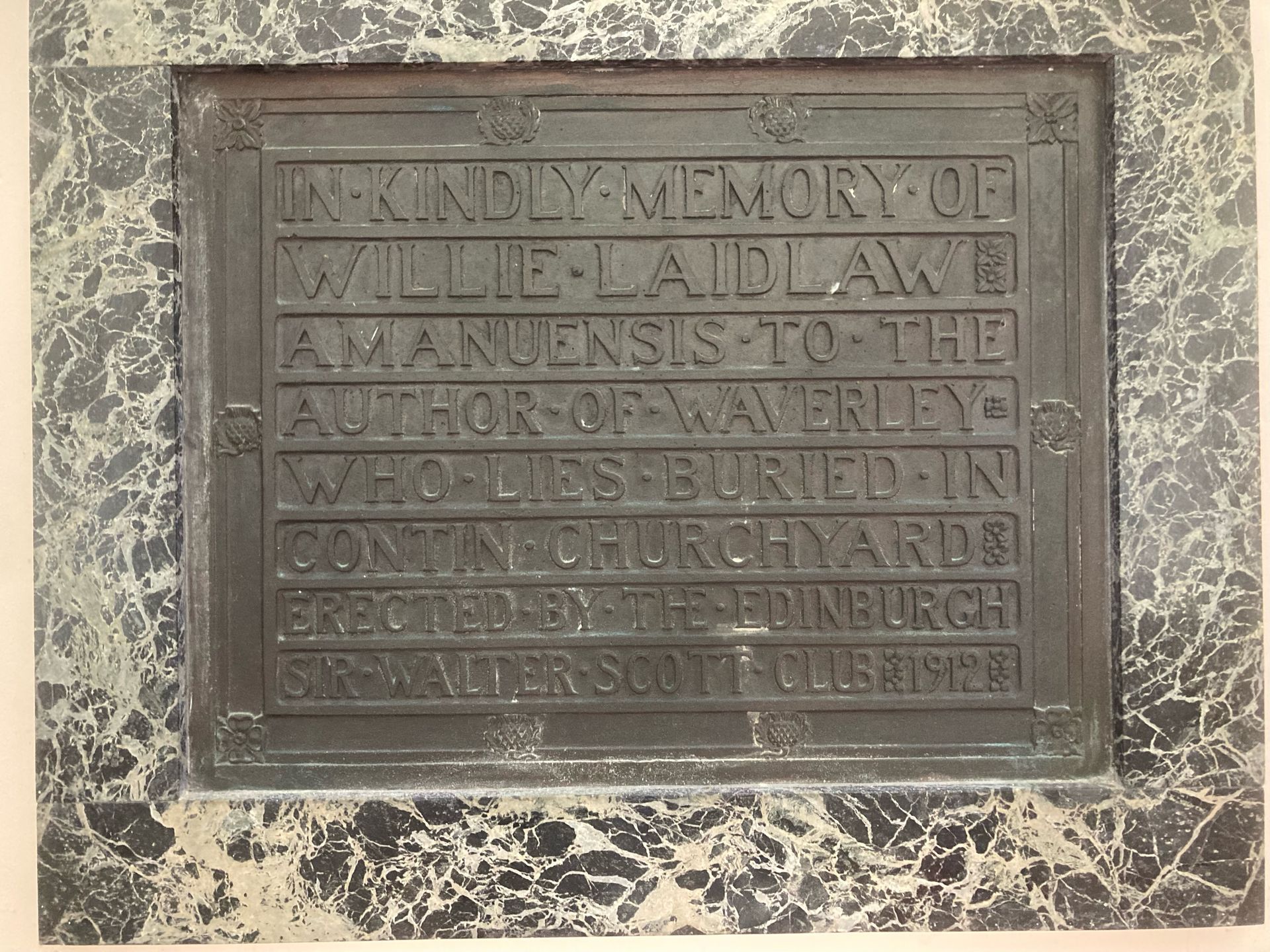
Image credit: Ronald Gall, Minister of
Fodderty & Strathpeffer with Contin,
Church of Scotland
