

A private viewing of the Interleaved Set of the Waverley Novels (the so-called ‘Magnum Opus’) and the Pforzheimer Scott Manuscripts repatriated from the United States
A report on the importance of the 1986 event
The Exile and Return of Scott’s Magnum Opus: The 1986 Repatriation
On 28th March 1986, the National Library of Scotland formally received Scott’s interleaved Magnum Opus and the Pforzheimer manuscripts, marking their return to Scotland after decades in exile.
Later in the year on 10th December 1986, members of the Edinburgh Sir Walter Scott Club were given a rare privilege: a private viewing of two of the most significant Scott acquisitions of the twentieth century — the Interleaved Set of the Waverley Novels, known as the ‘Magnum Opus’, and the Pforzheimer Scott manuscripts, newly returned from the United States. The viewing was conducted by Dr Iain Gordon Brown of the National Library of Scotland, who had been closely involved in securing their acquisition.
What the Club saw that evening represented not merely rare books and manuscripts, but the closing of a long historical circle.
What is the ‘Magnum Opus’?
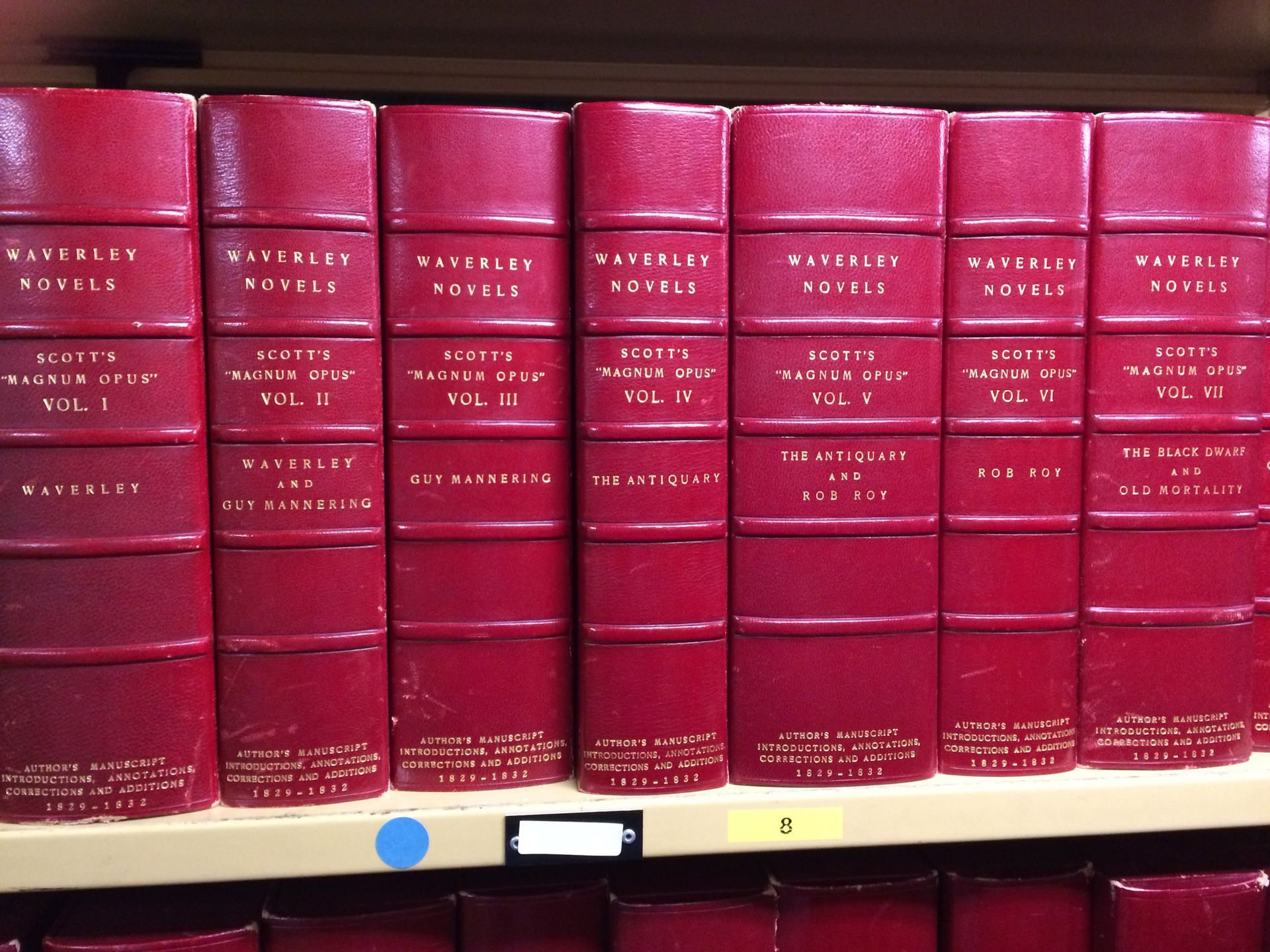
The so-called ‘Magnum Opus’ refers to Sir Walter Scott’s final collected edition of his novels, published between 1829 and 1833. Formally titled the Magnum Opus edition of the Waverley Novels, it was far more than a simple reprint.
After the financial crash of 1826, Scott undertook the enormous labour of revising, annotating and contextualising his earlier fiction. He added introductions, historical notes and corrections, shaping how posterity would read his work. To do this, he used a specially prepared interleaved set — printed volumes with blank leaves inserted between printed pages — on which he wrote extensive annotations and revisions in his own hand.
These interleaved volumes are the working foundation of the Magnum edition. They contain Scott not as the romantic novelist of legend, but as a disciplined editor, scholar and craftsman, labouring under financial strain and failing health to restore his fortunes and define his literary legacy.
Dispersal and disappearance
After Scott’s death, many of his manuscripts and annotated volumes passed through the hands of his publisher Robert Cadell and subsequently into private collections. Over the decades, portions of the interleaved Magnum set were exhibited, sold, and dispersed.
By the twentieth century, the full set had effectively vanished from scholarly view. Bibliographers speculated about its whereabouts. Individual volumes surfaced occasionally, but the integrity of the collection seemed lost. Like so many British literary manuscripts, parts of Scott’s legacy had crossed the Atlantic into American collections.
Among these was the distinguished collection of Carl H. Pforzheimer in New York, whose library contained important Scott manuscripts and related material.
The turning point
The dramatic change came in the mid-1980s. In 1984, part of the Interleaved Set was identified in private hands. The discovery triggered urgent negotiations by the National Library of Scotland. What followed was a complex and delicate process, culminating in 1986 in the successful acquisition — by private treaty — of all forty-one volumes of the interleaved Magnum set.
Almost immediately thereafter, the Library also secured the Pforzheimer Scott manuscripts from the United States. The proximity of the two acquisitions was remarkable. Within a short span, Scotland regained two major bodies of Scott material that had long been beyond its borders.
The acquisitions were commemorated in a 1986 publication issued by the National Library of Scotland, containing essays by Iain Gordon Brown and others. Brown’s contribution, titled “The Exile and Return of the ‘Magnum Opus’”, traced the wanderings of the set and reflected on its significance as both literary artefact and national treasure.
Why it mattered
The return of the Interleaved Set was not merely symbolic. For textual scholarship, it was transformative.
The volumes preserve Scott’s working process in unprecedented detail. They show his corrections, expansions, reconsiderations and historical clarifications. They illuminate how he reshaped earlier texts in light of later reflection. They reveal the intellectual discipline behind the popular romances.
Biographically, the volumes also document Scott’s extraordinary resilience after the crash of 1826. The Magnum project was part of his determined effort to repay his debts in full. The annotations are therefore not only literary revisions; they are evidence of endurance.
The repatriation also had cultural significance. At a time when many major literary archives had been dispersed abroad, the return of such a substantial body of material marked a decisive moment in the consolidation of Scotland’s national collections.
The 1986 viewing
When Dr Iain Gordon Brown presented the material to the Edinburgh Sir Walter Scott Club in 1986, members were not simply being shown rare books. They were witnessing the re-gathering of a dispersed inheritance.
The interleaved volumes — once scattered and nearly forgotten — had come home. The Pforzheimer manuscripts, long housed in America, now stood alongside them in Edinburgh. For scholars, librarians and Scott enthusiasts alike, the event represented the restoration of continuity: Scott’s hand, his revisions, his final shaping of his fiction, once more accessible in the city that had formed him.
Nearly four decades on, that moment still resonates. The story of the Magnum Opus is itself Scottian in character — involving loss, wandering, rediscovery and return. It reminds us that literary history is not static. Manuscripts travel. Collections fragment. Scholarship waits.
And sometimes, against the odds, the pieces come back together.
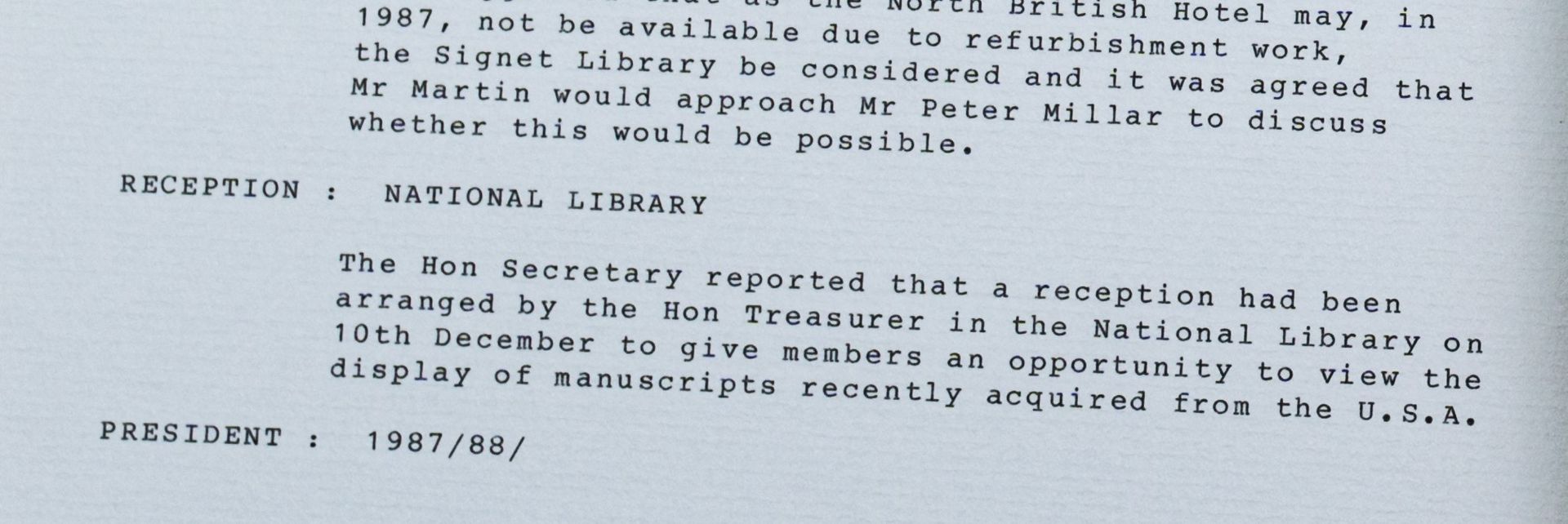
From the Club Minute Books - 5th November 1986
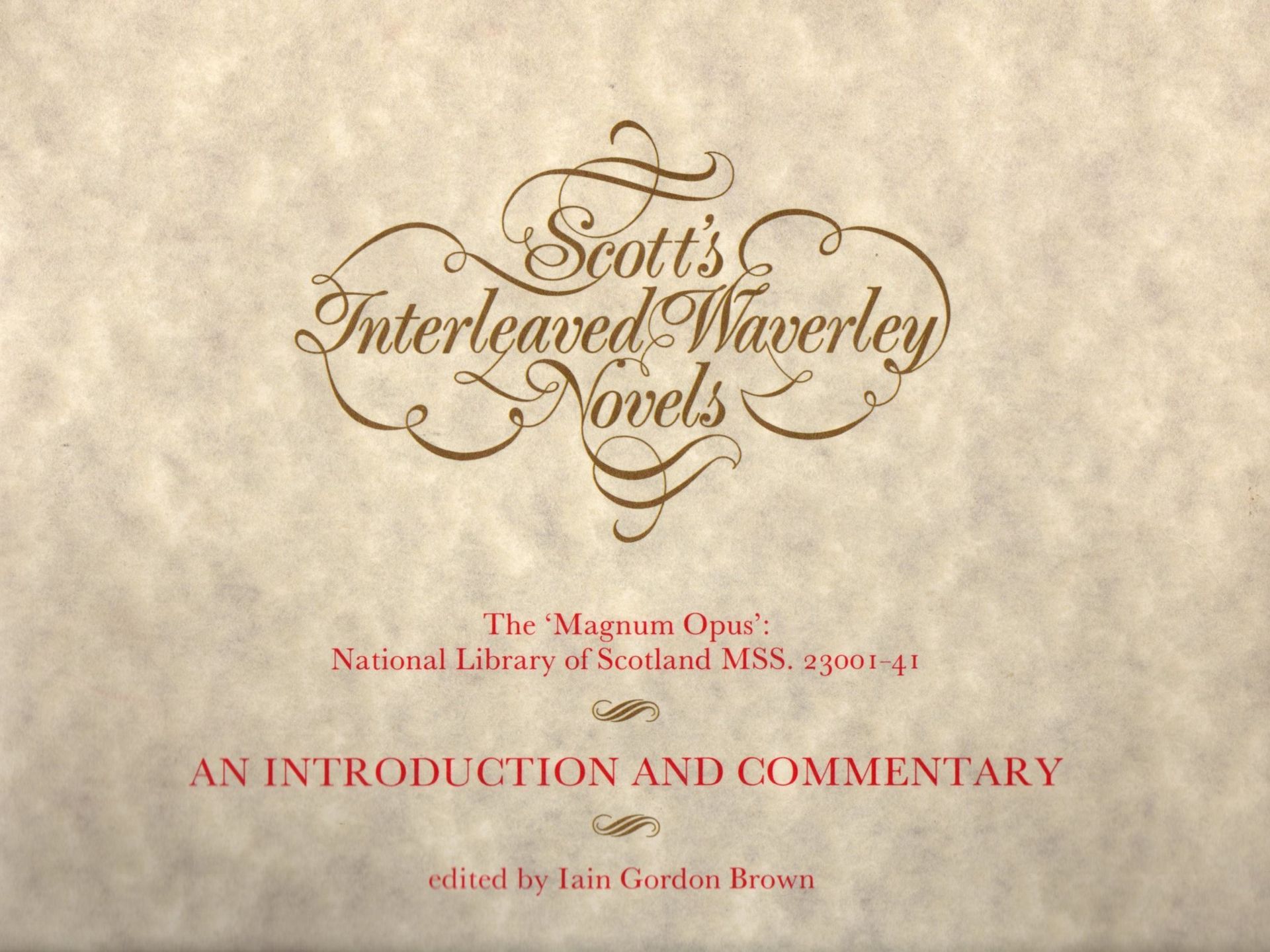
While a commemorative booklet was issued in 1986 to mark the acquisition of the Interleaved Set and the Pforzheimer manuscripts, the definitive scholarly treatment followed the next year.
In 1987, Iain Gordon Brown edited Scott’s Interleaved Waverley Novels: An Introduction and Commentary (Aberdeen and Oxford: Aberdeen University Press and Pergamon Press). This substantial volume brought together major essays by Professor Jane Millgate, Dr Claire Lamont and Dr J. H. Alexander, alongside Brown’s own extended study and three further major sections.
The book remains the foundational modern account of the Interleaved Set and its significance for Scott’s editorial practice.
Sir Walter Scott’s Magnum Opus and the Pforzheimer Manuscripts:
Essays to Commemorate the Acquisition of Two Great Collections by the National Library of Scotland
The essays in the 1986 National Library of Scotland publication explain both the scholarly importance of the Interleaved Waverley Novels and the remarkable circumstances that led to their return to Scotland. Jane Millgate describes how Sir Walter Scott used the interleaved volumes as working copies while preparing the Magnum edition of his novels (1829–1833), inserting corrections, new introductions, and extensive historical notes that shaped the final form of his fiction. Iain Gordon Brown traces the later history of these annotated volumes, which passed from Scott’s publisher Robert Cadell to A. & C. Black before being quietly sold to America in 1929 and effectively disappearing from scholarly view for decades. Their rediscovery in the library of the American collector Doris Louise Benz in 1984 led to a major campaign that secured their return to Edinburgh in 1986. Patrick Cadell’s essay describes the related group of manuscripts assembled by the American bibliophile Carl H. Pforzheimer, including manuscripts of Quentin Durward, The Betrothed, The Fair Maid of Perth, and The Lord of the Isles. Together these acquisitions significantly strengthened the National Library of Scotland’s already outstanding Scott collections and provided scholars with new insight into the author’s working methods and literary legacy.
Jane Millgate - The Interleaved Waverley Novels
(Summary of Essay)
Jane Millgate explains that the interleaved set of the Waverley Novels was created to prepare Sir Walter Scott’s final collected edition of his fiction, known as the Magnum Opus edition (1829–1833). Scott had originally published the novels anonymously, and only publicly acknowledged authorship in 1827 after the financial collapse of his publishers forced him to reveal himself as the “Author of Waverley”.
The idea for an annotated edition had first been suggested by Scott’s publisher Archibald Constable in 1823. After Constable’s bankruptcy in 1826, Robert Cadell eventually revived the plan and became Scott’s principal publisher. To produce the new edition, Cadell supplied Scott with printed copies of earlier editions of the novels in which blank pages had been inserted between the printed leaves. These interleaved volumes allowed Scott to revise the texts and compose extensive new introductions, notes, and appendices.
The forty-one-volume set preserves the working process behind this monumental editorial project. The first thirty-two volumes contain Scott’s manuscript revisions and annotations, while the remaining volumes contain supplementary material for the later novels. Scott used the blank leaves to write corrections, new historical notes, and commentary explaining sources and background for the stories. Additional material—sometimes written on separate sheets—was inserted into the volumes and later bound into place.
Millgate shows that the interleaved set does not consist of specially printed books but rather of earlier collected editions assembled together for Scott’s working use. The surviving volumes also reveal details of how the Magnum edition was physically produced: different paper stocks, inserted sheets, and later bindings demonstrate how the material was gathered and organised during the editorial process.
The manuscripts show Scott working intensively between about 1828 and 1831, revising the novels while also adding large amounts of historical and antiquarian commentary. Even late in the printing process he continued inserting new material, determined that the edition should contain every useful piece of information he could provide. Proof sheets and inserted documents show that he continued refining the notes even while the volumes were going through the press.
The interleaved set therefore provides exceptional evidence of Scott’s methods as an editor. It reveals how carefully he reconsidered the language and structure of his novels and how he reshaped them with introductions and explanatory notes designed to guide readers’ understanding of the historical settings.
Millgate concludes that the significance of the interleaved volumes lies not simply in their relationship to the published Magnum edition, but in the detailed insight they provide into Scott’s creative and editorial process. They document the enormous labour he invested in the project during the final years of his life, when financial pressure and declining health might easily have led him to treat the task superficially. Instead, the manuscripts demonstrate Scott’s determination to produce a definitive and authoritative edition of his works.
Iain Gordon Brown - The Exile and Return of the Magnum
(Summary of Essay)
Iain Gordon Brown traces the remarkable history of Sir Walter Scott’s interleaved set of the Waverley Novels — the working volumes used to prepare the Magnum edition (1829–1833) — from the nineteenth century to their return to Scotland in 1986.
After Scott’s death, the interleaved volumes formed part of the literary papers collected by his publisher Robert Cadell. When Cadell’s trustees sold the copyrights and related materials in 1851 to the publishing firm of A. & C. Black, the forty-one interleaved volumes passed with the transaction. They were recognised as a valuable record of Scott’s final corrections and annotations, and some volumes were exhibited publicly, including at the Scott Centenary Exhibition in Edinburgh in 1871 and at the Scottish Exhibition in Glasgow in 1911.
Despite their importance, the set gradually faded from scholarly awareness. In 1929 A. & C. Black quietly sold the entire collection to the American bibliophile J. H. Isaacs (known as “Temple Scott”), who soon produced a descriptive pamphlet celebrating the acquisition. The set was later acquired by the New York bookseller James F. Drake and eventually sold to Doris Louise Benz of Massachusetts, a private collector whose remarkable library remained largely unknown to scholars.
For decades the whereabouts of the Magnum set remained uncertain, and it effectively disappeared from view. During this period Scottish literary scholarship was flourishing, particularly around the centenary of Scott’s death in 1932, yet remarkably little attention was paid to the disappearance of these crucial manuscripts.
The mystery was finally resolved in 1984 following the death of Doris Benz. When her library was examined in preparation for sale, part of the Magnum set unexpectedly surfaced. After extensive searches, the remaining volumes were also located. Recognising the extraordinary importance of the discovery, the National Library of Scotland moved quickly to secure the collection for the nation.
Negotiations with the trustees of the Benz estate and with Christie’s eventually resulted in a private treaty sale rather than a public auction. The Library launched a major fundraising campaign and public appeal to raise the necessary funds. In March 1986 the entire interleaved set returned to Edinburgh, more than half a century after leaving Britain.
Brown concludes that the return of the Magnum volumes represents far more than the recovery of a rare book collection. The manuscripts contain the detailed record of Scott’s final revisions, introductions, and annotations for the definitive edition of his novels. Their rediscovery opens new possibilities for scholarship and promises to play an important role in the future editing and study of Scott’s works.
Patrick Cadell - The Pforzheimer Scott Manuscripts
(Summary of Essay)
Patrick Cadell describes the origins and significance of the group of Sir Walter Scott manuscripts collected by the American bibliophile Carl H. Pforzheimer and later acquired by the National Library of Scotland. Pforzheimer (1879–1957) was one of the great twentieth-century collectors of English literature, assembling a remarkable private library with particular strength in Romantic authors such as Shelley. His Scott manuscripts were gathered gradually between 1919 and 1956 through major auctions and private purchases.
The core of the collection includes manuscripts of several important works: Quentin Durward, The Lord of the Isles, The Betrothed, and The Fair Maid of Perth, together with proofs, articles, and other literary pieces by Scott. Many of these manuscripts had earlier belonged to Scott’s publisher Robert Cadell and were dispersed during nineteenth-century sales of Cadell’s literary papers. Some were later reunited within Pforzheimer’s library after passing through the hands of various collectors and dealers.
Cadell notes that Pforzheimer collected Scott manuscripts selectively and with clear purpose rather than simply acquiring autograph material indiscriminately. His collection therefore represents a carefully chosen cross-section of Scott’s literary career, including works from different periods and genres. The manuscripts also reflect the wide range of Scott’s writing—from major historical novels to poetry and occasional prose pieces.
Although the Pforzheimer collection contained some letters by Scott, correspondence was not a major focus of the acquisition that came to Scotland. Instead, the strength of the material lies in literary manuscripts and proof material showing Scott’s working methods. When these manuscripts were acquired by the National Library of Scotland they complemented an already strong Scott archive, which included important novel manuscripts such as Waverley, The Heart of Midlothian, and Redgauntlet, as well as extensive correspondence and poetry.
Cadell concludes that the arrival of the Pforzheimer manuscripts significantly strengthened the National Library’s Scott holdings. By bringing together manuscripts of both novels and long poems, the acquisition deepened the Library’s representation of Scott’s creative work and enhanced its role as a central repository for the study of Scotland’s most influential literary figure.
